The Chicago Bears' offense couldn't have asked for a much better start to the 2026 season.
Chicago erupted for 59 points and 552 total yards in its 59-37 victory over the Carolina Panthers, with D'Andre Swift and Kyle Monangai each topping 100 rushing yards and Caleb Williams accounting for four touchdowns.
But Pro Football Focus' grades paint a surprisingly different picture of Williams' performance.
To avoid overreacting to players who appeared for only a handful of snaps, we'll use a minimum of 20 offensive snaps to evaluate the Bears' best and worst PFF grades. That eliminates small-sample performances such as Theo Benedet's 69.1 grade on 19 snaps, Kaden Davis' 57.7 on 10, and Sam Roush's 53.8 on 12.
And even with that threshold, PFF's evaluation of Williams is difficult to understand.
D'Andre Swift leads Bears' highest-graded players
Swift didn't just pass the eye test in Week 1. PFF's analytics thought he was spectacular, too.
The Bears running back earned a 90.7 overall grade, the highest among Chicago offensive players who logged at least 20 snaps. He also received a 90.9 rushing grade.
Swift carried 18 times for 124 yards and three touchdowns as the Bears' running game overwhelmed Carolina. Monangai added 100 yards, including a 61-yard touchdown, as Chicago finished with 291 rushing yards.
Kalif Raymond was right behind Swift with a 90.2 overall grade across 45 offensive snaps. He earned an 86.8 receiving grade and an 84.2 run-blocking grade.
The offensive line also had two performances PFF loved.
Right guard Jonah Jackson earned an 85.7 overall grade, highlighted by an 88.7 pass-blocking grade. Right tackle Darnell Wright finished at 84.0, with PFF giving him an impressive 88.5 run-blocking grade.
Cole Kmet rounded out the group of Bears players above 80, earning an 84.6 overall grade over 43 snaps.
Those grades generally align with an offense that controlled the game and produced one of the biggest offensive performances in franchise history.
Then there's Williams.
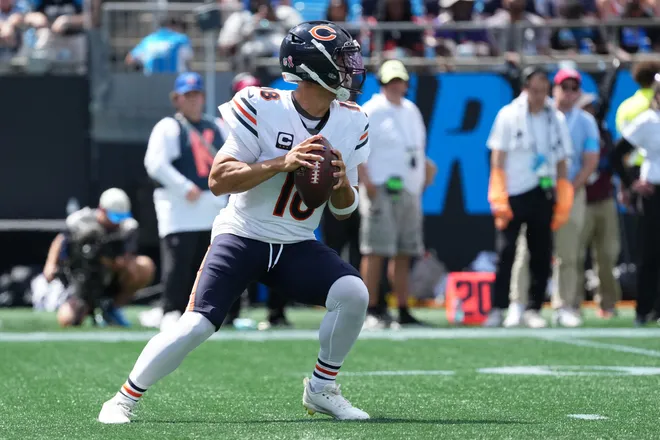
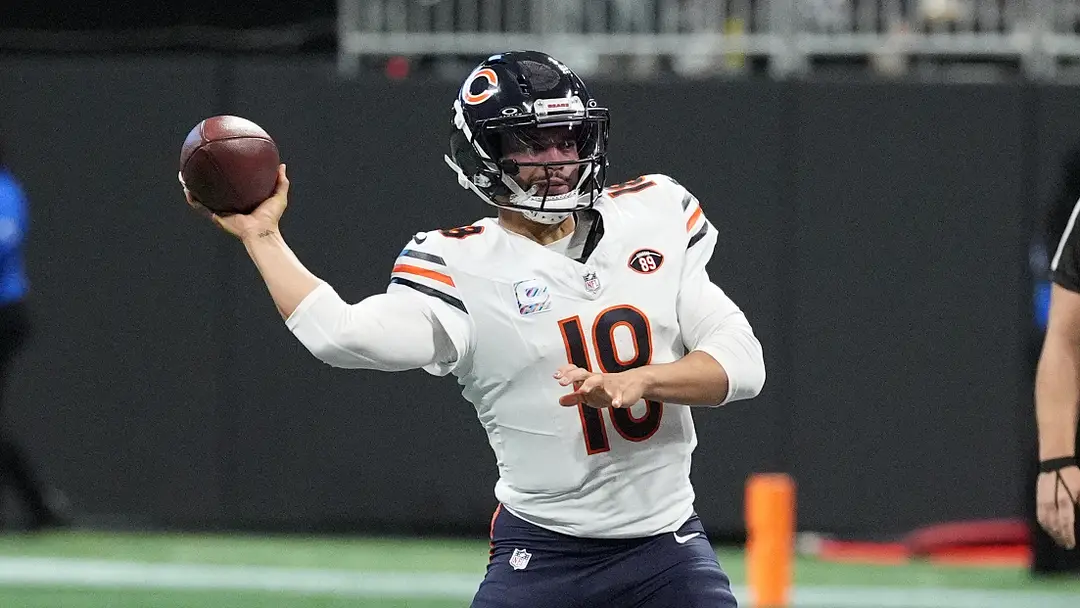
Jim Dedmon-Imagn Images
PFF's Caleb Williams grade doesn't pass the smell test
PFF gave Williams a 60.4 overall grade. His passing grade was only slightly better at 61.5.
Say what?!
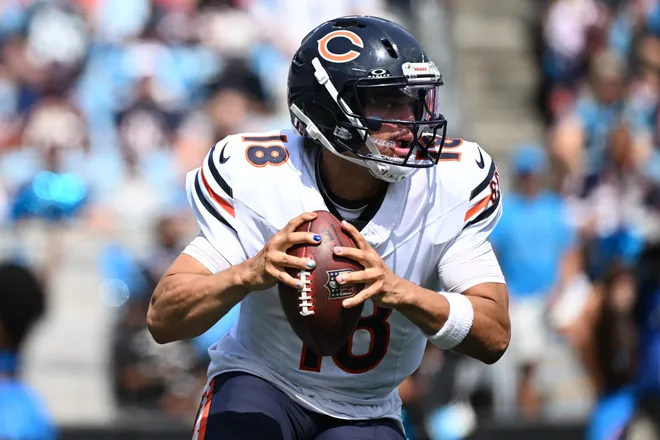
Williams completed 21 of 29 passes for 269 yards and two touchdowns (and no interceptions!). He added 65 yards and two more touchdowns on the ground.
That's 334 total yards, four touchdowns and zero turnovers while completing 72.4% of his passes. His passer rating was 123.8.
More importantly, Williams wasn't simply piling up meaningless production. He was running an offense that scored 59 points and accumulated 552 yards. Chicago's 59 points were the most it has ever scored in a season opener, while its 552 yards were the second most in a Week 1 game in franchise history.
Was Williams flawless? No. There were throws and opportunities he'll want back, and PFF's grading system is specifically designed to evaluate individual plays rather than simply reward a quarterback for his final stat line.
But at some point, a grading system has to reflect reality.
Williams produced four touchdowns without committing a turnover. He completed nearly three-quarters of his passes. He averaged 9.3 yards per passing attempt and 6.5 yards per carry. He repeatedly created offense with his legs and helped Chicago score touchdowns on eight possessions.
And PFF came away with a 60.4?
That's not merely lower than his statistics might suggest. It's a grade that portrays Williams' performance as ordinary. And there was nothing ordinary about it.
PFF was much harsher on several Bears starters
Using the 20-snap minimum, we also have to take a look at the other end of the spectrum: the guys who didn't fare so well on offense.
Center Garrett Bradbury finished last among qualifying Bears with a 49.9 overall grade across all 75 offensive snaps. PFF gave him a 43.5 pass-blocking score and a 51.3 run-blocking grade.
Colston Loveland wasn't far ahead at 51.6 over 65 snaps. His receiving grade was just 47.4. His lack of production was one of the more surprising events of Week 1. Loveland has been touted as one of the breakout superstars of 2026, but he ended the opener with zero catches.
Rome Odunze received a 59.2 overall grade across 36 snaps, while Joe Thuney checked in at 60.2 over all 75.
And then, remarkably, comes Williams at 60.4. And that's what makes his grade stand out even more. PFF essentially placed Williams in the same neighborhood as the lowest-graded regulars on an offense he quarterbacked to 59 points.
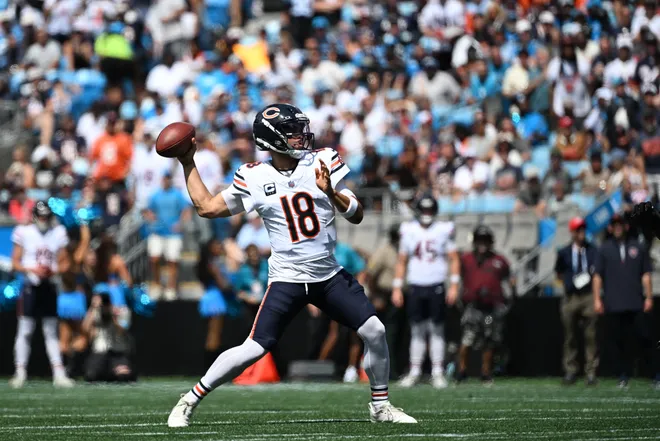
Bob Donnan-Imagn Images
This is exactly why PFF grades need context
PFF grades can be useful. They provide another layer of evaluation beyond box scores, and they're valuable for positions where individual performance isn't easily captured by traditional statistics.
But they shouldn't override what actually happened on the field.
Swift's 90.7 makes perfect sense. Jackson and Wright grading well fits an afternoon when the Bears rushed for nearly 300 yards. Bradbury and Loveland may also have legitimate individual mistakes behind their poor grades that weren't obvious in the overall offensive explosion.
Williams is different, though.
A quarterback completing 72.4% of his passes, averaging 9.3 yards per attempt, accounting for 334 yards and four touchdowns, and committing zero turnovers shouldn't need his performance rescued by context.
PFF watched one of the most explosive season-opening offensive performances in Bears history and determined the quarterback responsible for directing it deserved a 60.4.
Sometimes the grade tells us something the box score doesn't. This time, the grade might tell us more about the limitations of the grading system than it does about Caleb Williams.
BearsTalk Analytics2026 season
How the players in this story are grading
68.4D'Andre Swift. BTX grade 68.35 out of 100, rank 16 among 78 qualified running backs.
70.6Kalif Raymond. BTX grade 70.6 out of 100, tied for rank 20 among 139 qualified wide receivers.
37.1Cole Kmet. BTX grade 37.05 out of 100, rank 55 among 85 qualified tight ends.
57.5Rome Odunze. BTX grade 57.5 out of 100, rank 44 among 139 qualified wide receivers.
36.0Colston Loveland. BTX grade 35.95 out of 100, rank 58 among 85 qualified tight ends.
Comments
Join the Conversation
Sign up to comment on this story
Create a free BearsTalk account to comment, earn points, and join the community.
Loading comments…